
 Hard Services
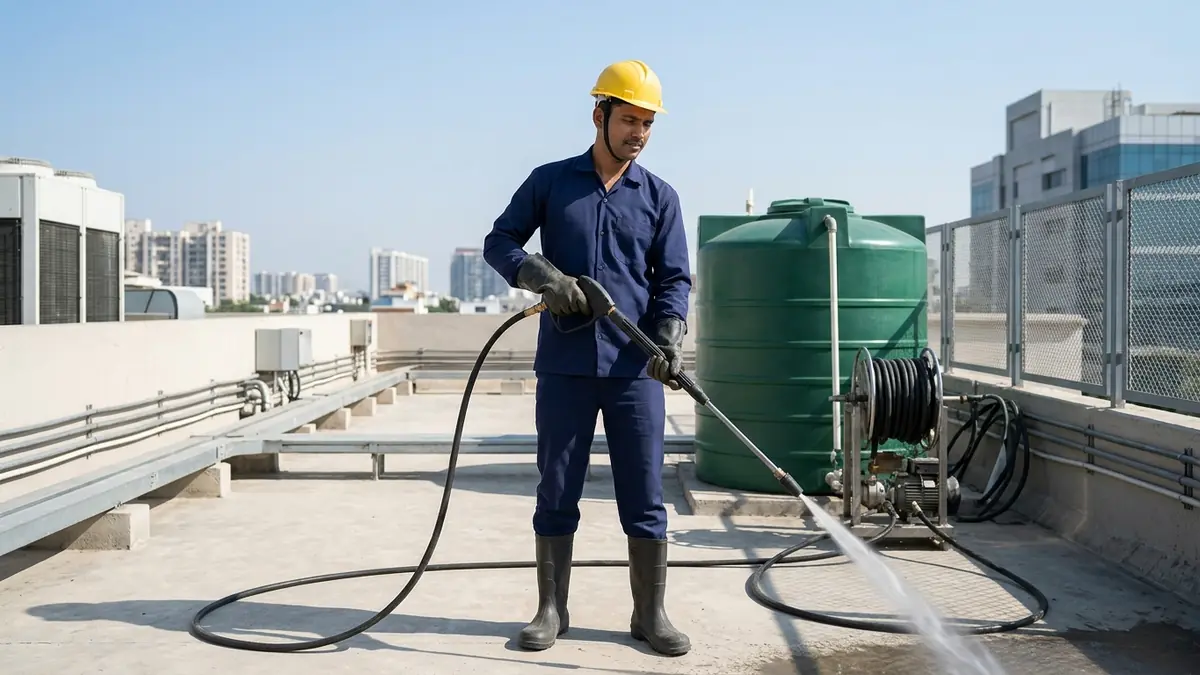
Clean water forms the operational baseline of every commercial facility, from corporate IT towers and manufacturing hubs to multispecialty healthcare centres. In modern commercial structures, municipal supplies and borewell water enter underground concrete sumps before being pumped to elevated rooftop tanks. While water appears clear from surface observation, the dark interior of storage tanks accelerates sediment settlement, chemical calcification and microbial colonization. Deploying a structured 5 stage water tank cleaning process protects drinking water infrastructure against microbial contamination, heavy mineral scaling and toxic silt accumulation.
Traditional cleaning methods across Indian commercial establishments have long depended on unorganized manual labourers scraping walls with metal scrapers and dirty wire brushes. This unscientific practice scratches waterproof plaster, fails to dislodge embedded biological films and introduces external cross-contamination through dirty footwear and unsterilised buckets. Microscopic pathogens like Escherichia coli, Salmonella and Legionella pneumophila form stubborn cellular protective layers known as biofilms that withstand basic water rinses and manual wiping.
Facility directors, corporate EHS leads and plant operations managers require an engineering-grade decontamination standard. Scientific water tank sanitisation replaces manual scraping with high-pressure water jetting, industrial sludge vacuuming and ultraviolet radiation. This definitive technical guide details the 5 stage water tank cleaning process, maps regulatory compliance under Bureau of Indian Standards guidelines and establishes why routine mechanized disinfection is essential for facility longevity and tenant health.
GUIDE INDEX Table of Contents Quick Navigation
- 01 5 Stage Water Tank Cleaning Process: Technical SOP
- 02 Scientific Breakdown: Dewatering, Desludging and Jetting
- 03 Disinfection Chemistry: Anti-Bacterial Fogging and UV
- 04 Water Tank Cleaning Frequency, Health Hazards and BIS 10500
- 05 Confined Space Safety for Underground Sump Cleaning
- 06 AMC Integration, Cost Efficiency and Audit Certification
- 07 Frequently Asked Questions (FAQs)
5 Stage Water Tank Cleaning Process: Technical Engineering SOP
The 5 stage water tank cleaning process replaces manual scraping with five sequential engineering phases: high-flow slurry dewatering, mechanized bottom sludge vacuuming, 150-bar rotary pressure jetting, food-grade antibacterial misting and UV-C germicidal sterilisation. This closed-loop standard eliminates 99.9% of microbial pathogens and biofilms without scratching tank plaster.
Transitioning from primitive scrubbing to a mechanized standard requires strict adherence to sequential engineering protocols. Skipping a single phase compromises the entire decontamination cycle. For example, applying disinfectant chemicals over an unextracted mud layer neutralises the sanitising compound before it touches the reservoir wall. Our specialized team for mechanized water tank cleaning services executes a calibrated five-stage sequence designed to restore commercial storage vessels to aseptic conditions.
Every commercial water reservoir, whether a 5,000-litre overhead polyethylene tank or a 5,00,000-litre reinforced concrete underground sump, undergoes this five-tier operational protocol:
Stage 01 • Dewatering
High-Flow Slurry Dewatering
Isolating supply manifolds and deploying high-capacity submersible pumps to evacuate stagnant water.
Flow Control Inlet and outlet distribution valves are tagged and locked to isolate building plumbing lines completely.
Equipment Deployed Heavy-duty non-clog submersible dewatering pumps running at 15,000 to 25,000 litres per hour.
Discharge Standard Water is evacuated down to the bottom 150 mm sediment zone and routed to external storm drains.
Stage 02 • Desludging
Mechanized Sludge Removal
Extracting dense industrial mud, silt, calcified scales and decomposed organic matter from the floor.
Extraction Method Industrial wet slurry vacuum machines with multi-stage bypass motors suctioning dense bottom sediment.
Sludge Elimination Zero manual bucket handling, preventing messy roof spills and protecting drainage pipes from choking.
Surface State Floor slabs and sump sumpholes are stripped down to the bare masonry or epoxy coating.
Stage 03 • Pressure Jet
150-Bar Rotary Jet Scrubbing
Stripping microbial biofilms, green algae colonies and stubborn mineral deposits from vertical walls and ceilings.
Hydraulic Pressure Calibrated 120 to 150-bar rotary nozzles producing high-impact oscillating water streams.
Biofilm Scouring High velocity dislodges embedded slime matrices without damaging waterproofing compounds or structural joints.
Coverage Zones Top ceiling slabs, access manholes, internal ladders, structural pillars and corner fillet seams.
Stage 04 • Sanitisation
Anti-Bacterial Mist Spray
Applying food-grade, non-hazardous antibacterial formulations to neutralise microscopic bacterial colonies.
Chemical Specification Biodegradable, non-toxic bio-enzymatic spray safe for potable drinking water reservoirs.
Dwell Contact Time Mandatory 20-minute active contact time allowed to penetrate microscopic concrete fissures and kill spores.
Residue Clearance Subsequent high-pressure freshwater rinse drains all spent solution, leaving zero toxic by-products.
Stage 05 • Sterilisation
UV-C Germicidal Disinfection
Irradiating interior surfaces with ultraviolet light to eradicate residual airborne and surface-bound microbes.
Wavelength Standard Short-wave 253.7 nm UV-C germicidal light that disrupts microbial DNA and RNA cellular chains.
Zero Chemicals Physical sterilisation leaves no chemical taste, no toxic chloramines and no residual synthetic odour.
Final Status Tank is immediately ready for water refilling and distribution without lengthy aeration delays.
Scientific Breakdown: Dewatering, Desludging and High-Pressure Jetting
Physical dewatering and desludging remove over 90% of physical contaminants before chemical sanitisation begins. Industrial slurry extractors evacuate dense bottom muck containing decomposed organisms and mineral scales, while 150-bar rotary pressure jets scour vertical walls to strip protective microbial biofilms completely.
The physical preparation stages form the foundation of tank decontamination. In many industrial campuses, water tanks sit uninspected for years. Over time, incoming water leaves behind suspended silt, airborne dust drawn through unsealed ventilation cowls and calcium carbonate precipitation. This forms a dark, foul-smelling sludge blanket across the tank bed that constantly contaminates incoming potable water.
Executing overhead tank sludge removal without specialized slurry vacuums is hazardous and inefficient. When workers use handheld buckets, dirty sludge drips across roof slabs and clogs rainwater downspouts. More dangerously, manual workers walk over sludge with contaminated footwear, introducing faecal matter and urban pollutants directly into the tank. Mechanized slurry extraction uses external suction wands that draw sludge directly into sealed waste holding barrels, maintaining pristine rooftop cleanliness.
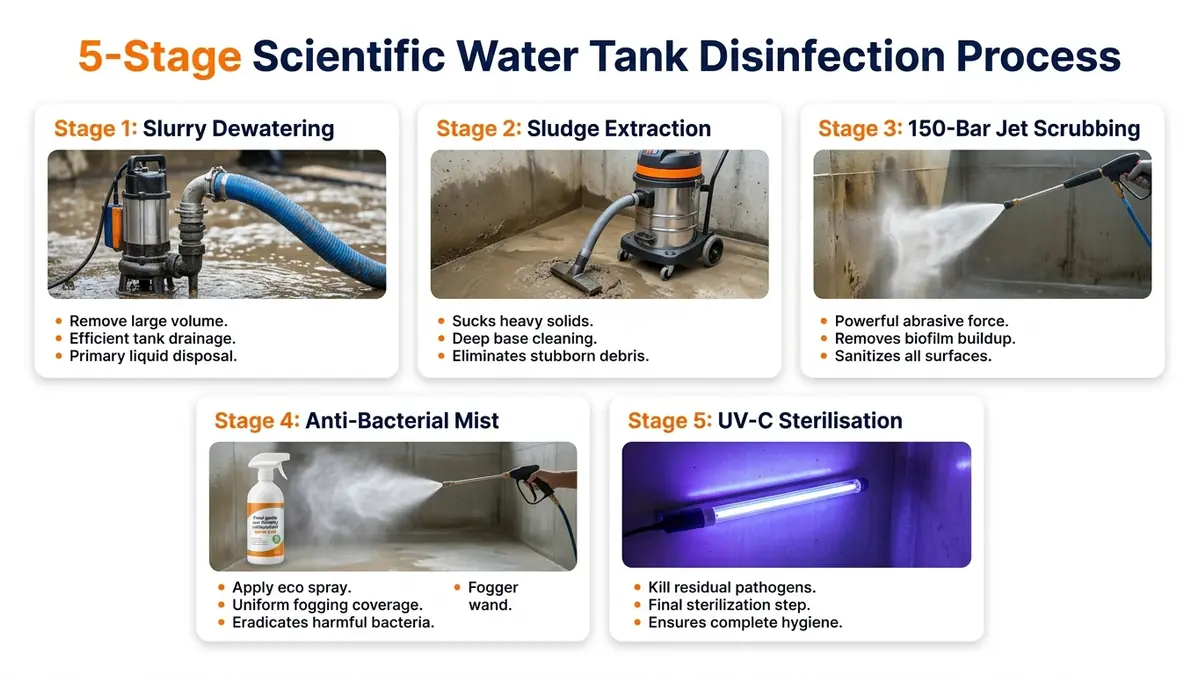
Once sludge is eliminated, high pressure water jetting tank cleaning scours structural concrete, stainless steel or molded polyethylene surfaces. Concrete tanks present a distinct challenge: their porous nature provides microscopic crevices where algae filaments anchor firmly. Using rotary jet wands calibrated to 150 bar creates a mechanical shearing force that peels away the cellular matrix of biofilms without gouging the concrete substrate. Combining this with professional mechanized housekeeping services ensures building operations maintain rigorous environmental standards.
| Evaluation Parameter | Primitive Manual Cleaning | Scientific 5-Stage Mechanized Process |
|---|---|---|
| Sludge Removal Method | Manual buckets and wire brushes scattering silt | Industrial heavy-duty wet slurry vacuum extraction |
| Biofilm Stripping | Ineffective; leaves biological slime in pores | 150-bar calibrated rotary pressure jet peeling |
| Disinfection Technology | Crude bleaching powder leaving strong chlorine taste | Food-grade antibacterial mist + 254 nm UV-C irradiation |
| Structural Plaster Safety | High risk of cracking waterproofing plaster | Non-destructive hydraulic washing protecting tank integrity |
| Microbial Reduction Rate | Less than 60% reduction; rapid re-colonization | 99.9% pathogen elimination certified by lab testing |
| Water Restoration Time | 12 to 24 hours due to persistent bleach fumes | Immediate refilling; odour-free and chemical-free |
Disinfection Chemistry: Anti-Bacterial Fogging and Water Tank UV Disinfection
Scientific disinfection combines non-toxic biodegradable antibacterial misting with 254 nm ultraviolet germicidal irradiation. Anti-bacterial formulations penetrate microscopic plaster cracks during a 20-minute dwell time, followed by UV-C exposure that scrambles residual pathogen DNA without leaving chemical residues or chlorine odours.
Disinfecting potable water storage vessels requires chemical precision. For decades, commercial property managers relied on dumping unmeasured calcium hypochlorite (bleaching powder) into empty tanks. While chlorine is a potent oxidizer, uncalibrated application creates severe risks. Excess free chlorine reacts with natural organic matter to form carcinogenic trihalomethanes (THMs). Furthermore, harsh bleaching leaves persistent caustic odours that render tap water unusable for days.
The modern scientific method relies on specialized water tank anti-bacterial spray treatment using food-grade bio-enzymatic agents. These formulations target bacterial cell walls, denaturing transport proteins in coliforms, Pseudomonas aeruginosa and Staphylococcus aureus. Applied using ultra-low-volume pneumatic misting wands, the micro-droplets coat every square centimetre of ceiling, wall and piping fixtures. A strict 20-minute contact dwell period allows the active ingredients to destroy spores embedded deep within surface fissures.
Following a high-pressure freshwater wash, the process culminates in water tank UV disinfection. High-intensity ultraviolet wands emitting germicidal wavelengths at exactly 253.7 nanometres pass over all interior surfaces. Ultraviolet radiation passes through pathogen cell membranes and is absorbed by cellular nucleic acids. This causes thymine dimerization in DNA chains, rendering bacteria, viruses and protozoan cysts sterile and incapable of reproduction. Because ultraviolet treatment is entirely physical, water refilled immediately afterward remains crystal clear, refreshing and completely odour-free.
Water Tank Cleaning Frequency, Health Hazards and BIS 10500 Compliance
Commercial facilities must clean water storage tanks every 6 months under National Building Code mandates, while healthcare and food processing units require quarterly sanitisation. Following BIS 10500 standards guarantees zero coliform presence, turbidity under 1.0 NTU and complete elimination of waterborne pathogens.
Maintaining potable water quality is both a health imperative and a statutory requirement. In India, water quality parameters are governed by the Bureau of Indian Standards under IS 10500:2012 Drinking Water Specification. According to this standard, drinking water supplied across residential, commercial and public establishments must contain zero coliform organisms per 100 ml sample, have a turbidity level below 1.0 Nephelometric Turbidity Units (NTU) and show an absence of harmful heavy metals.
Determining the correct overhead water tank cleaning frequency depends on the specific operational environment and structural risk profile of your property. Neglecting cleaning cycles leads to rapid accumulation of bio-film and pathogenic colonies that trigger gastrointestinal diseases, skin irritations and chronic indoor air contamination through cooling tower mist.
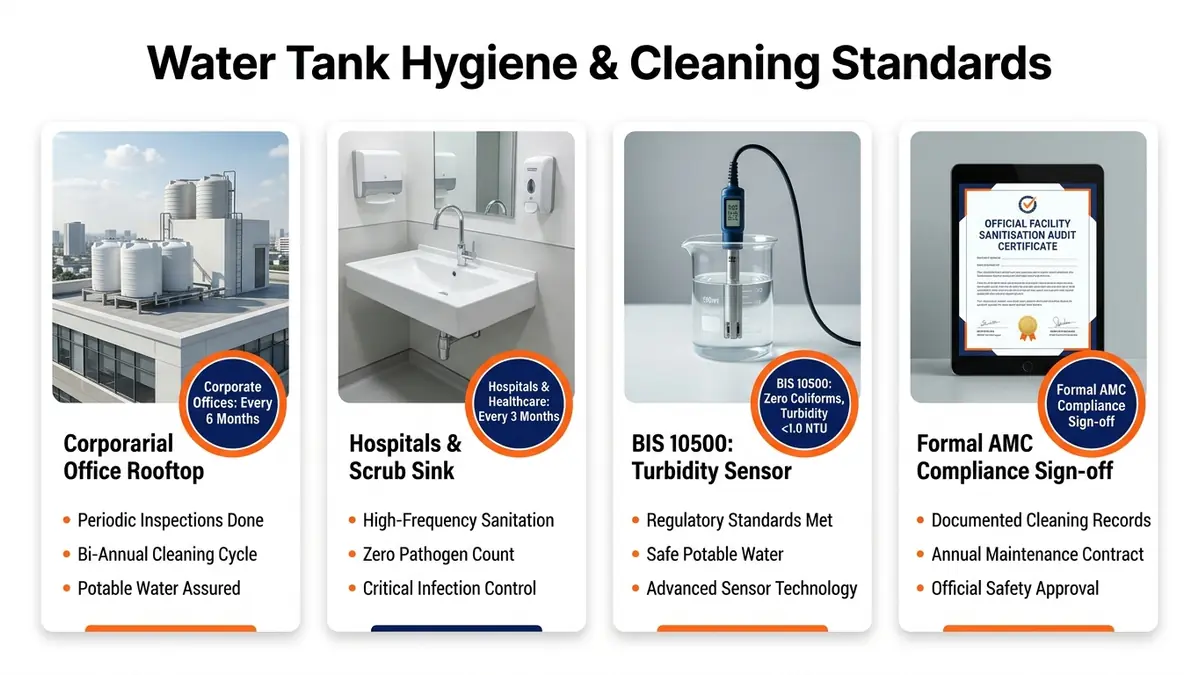
Corporate facility managers must align maintenance intervals with statutory requirements and facility usage patterns:
Corporate Offices & IT Parks
Bi-Annual Cycle (Every 6 Months)
Multi-tenant commercial towers with high employee footfall require structured cleaning every six months. Coordinating with quarterly MEP audits prevents plumbing scale accumulation and protects RO filtration membranes from early clogging.
Hospitals & Clinical Facilities
Quarterly Cycle (Every 3 Months)
Under NABH infection control protocols, hospital water supplies undergo quarterly tank sterilisation. High-risk critical zones like dialysis wings, ICUs and surgical scrub stations demand continuous microbiological testing and zero bacterial tolerance.
Pharma & Food Processing Plants
Quarterly Cycle (Every 3 Months)
GMP standards and FSSAI hygiene guidelines mandate rigorous quarterly decontamination. Storage tanks feeding manufacturing formulations, cleanrooms and ingredient blending lines must pass documented NABL microbial verification audits.
Residential Societies & Townships
Bi-Annual Cycle (Every 6 Months)
High-rise residential communities drawing hard groundwater experience accelerated sludge buildup. Scheduling bi-annual tank cleaning ahead of summer and the monsoon ensures resident health and prevents overhead pump failures.
Confined Space Safety Protocols for Underground Sump Cleaning
Underground sump cleaning requires specialized confined space safety protocols including multi-gas atmospheric testing, forced-air mechanical ventilation, full-body safety harnesses and 24-volt low-voltage equipment. These precautions eliminate risks of oxygen deficiency, toxic gas inhalation and accidental falls.
While overhead polyethylene tanks are easily accessed from rooftop ladders, underground concrete sumps present serious industrial safety hazards. Classified as confined spaces under industrial safety codes, deep sumps often trap hazardous heavier-than-air toxic gases such as hydrogen sulfide (H2S), methane (CH4) and carbon monoxide (CO). Furthermore, natural microbial decomposition of settled organic matter depletes ambient oxygen, creating a fatal hazard for unprotected workers entering without safety checks.
Executing an underground sump cleaning procedure demands certified engineering safety protocols. Before any technician enters a sump, our safety supervisors conduct a 4-gas atmospheric test using calibrated digital gas monitors. Oxygen concentration must read between 19.5% and 23.5% by volume and toxic gas levels must register zero parts per million. Explosion-proof forced-air blowers continuously circulate fresh air throughout the work shift to ensure positive cross-ventilation.
Technicians entering deep sumps wear full-body arrest harnesses anchored to an overhead aluminum tripod recovery winch. All electrical pumping machines, slurry vacuums and inspection lamps inside the moist sump operate on low-voltage 24V isolated transformer lines, preventing electrical shock hazards. Pairing water tank sanitisation with ongoing hard technical MEP engineering services provides building owners with integrated structural safety and peace of mind.
Step 1
Multi-Gas Atmospheric Screening
Digital 4-gas detectors verify safe oxygen levels (19.5%–23.5%) and confirm complete absence of toxic hydrogen sulfide, carbon monoxide and combustible methane gases.
Step 2
Forced Mechanical Ventilation
High-velocity pneumatic blowers purge stale stagnant air from the sump floor, maintaining continuous positive oxygen circulation for the duration of the cleaning shift.
Step 3
Tripod Winch & Fall Arrest Rigging
Technicians are equipped with three-point safety harnesses connected to an overhead retrieval tripod, ensuring immediate extraction capability without relying on interior ladders.
Step 4
24V Low-Voltage Electrical Safety
Submersible pumps, rotary jetters and LED inspection luminaires use moisture-sealed 24V power transformers, eliminating electrocution risks in wet concrete chambers.
AMC Integration, Cost Efficiency and Audit Certification
Integrating water tank sanitisation into an annual maintenance contract reduces overall cleaning costs by up to 35% compared to emergency on-call services. Every completed service includes high-resolution before-and-after photologs, NABL-accredited laboratory water test reports and statutory hygiene certificates.
Relying on ad-hoc, on-call cleaning vendors creates operational vulnerabilities. Property managers often discover contaminated water only after tenants file complaints or when plumbing lines clog with dislodged sludge flakes. Ad-hoc service calls carry premium emergency charges, create scheduling conflicts and rarely provide formal compliance documentation needed during corporate facility audits.
Incorporating water tank sanitisation into an integrated annual maintenance contract provides systematic preventive care. Scheduled maintenance is booked during off-peak hours or weekend maintenance windows, minimizing tenant inconvenience. Regular bi-annual cleaning prevents mineral calcification from eroding interior concrete surfaces, extending the operating life of structural storage assets by decades.
Every commercial sanitisation engagement delivered by Urja Facility concludes with a formal handover dossier. Facility managers receive timestamped digital photographic records documenting every stage, a comprehensive water tank hygiene audit checklist and an official Sanitisation Completion Certificate. Furthermore, we arrange post-cleaning drinking water biological testing BIS 10500 through NABL-accredited environmental testing laboratories, providing verifiable legal proof of water purity for your EHS records.
FAQs
Common questions regarding commercial water tank cleaning cover mandatory NBC cleaning frequencies, differences between manual scraping and 5-stage mechanized disinfection, chemical safety for drinking water, BIS 10500 testing criteria and compliance documentation for corporate audits.
How often should commercial water storage tanks be cleaned and disinfected?
Under the National Building Code (NBC 2016) and Central Public Health Environmental Engineering Organisation guidelines, commercial facilities and IT parks must clean overhead and underground tanks every 6 months. Healthcare facilities, pharmaceutical manufacturing plants and food processing units must clean and disinfect their tanks every 3 months.
What is the difference between manual water tank cleaning and the 5-stage mechanized process?
Manual cleaning relies on untrained workers using wire brushes and buckets, which merely spreads mud across concrete pores and risks structural cracking. The 5-stage mechanized process utilizes high-flow submersible pumps, industrial slurry vacuums, 150-bar rotary jet scrubbers, food-grade antibacterial mist and UV-C germicidal radiation to achieve zero-pathogen sterilisation.
Does the anti-bacterial mist or UV disinfection leave chemical odours in drinking water?
No. The antibacterial formulations used in scientific disinfection are biodegradable, non-toxic and food-grade. UV-C disinfection is completely physical and chemical-free, leaving zero chemical residues, zero chloramines and zero alteration in the natural taste, colour or odour of potable water.
What parameters are tested in drinking water biological testing BIS 10500 after cleaning?
Post-cleaning water quality testing under IS 10500:2012 verifies physical, chemical and bacteriological criteria. Essential tests confirm total coliform bacteria is zero CFU per 100 ml, E. coli and faecal streptococci are completely absent, turbidity is below 1.0 NTU and pH remains within 6.5 to 8.5.
Can underground sumps of 1,00,000 to 5,00,000 litres capacity be cleaned without excessive water wastage?
Yes. Urja Facility coordinates scheduled dewatering cycles by advising facility managers to stagger incoming municipal supply and run down usable water before the maintenance shift begins. Only the bottom sediment slurry and dead storage volume are evacuated through high-capacity slurry vacuums.
Is water tank cleaning mandatory for corporate environmental, health and safety (EHS) audits?
Yes. Corporate governance standards, ISO 14001, ISO 45001, FSSAI regulations and NABH hospital accreditation mandate documented evidence of bi-annual or quarterly water tank sanitisation, supported by NABL-accredited laboratory test certificates and photographic inspection logs.