 Corporate
A modern hospital can invest crores in diagnostic scanners, modular operation theatres and distinguished medical specialists. However, if environmental hygiene slips, the entire care delivery system struggles under the threat of Hospital-Acquired Infections (HAIs). In Indian healthcare institutions, maintaining clinical cleanliness directly impacts patient recovery, statutory accreditation and community trust.
Hospital administrators and infection control committees face a clear operational challenge: balancing heavy patient footfall with strict sterilization protocols. Relying on untrained ad-hoc cleaners or generic commercial sweepers frequently leads to chemical dilution errors, missed contact points and failed NABH audits. Learning how to maintain hospital sanitization standards through a structured Annual Maintenance Contract (AMC) gives hospital leaders a dependable system to safeguard patients and clinical workflows.
In this guide, we examine clinical zoning frameworks, chemical dilution rules, sterile area procedures and biomedical waste disposal steps needed to run a sterile healthcare facility.
GUIDE INDEX Table of Contents Quick Navigation
- 01 Infection Control Cleaning Protocols Across Risk Zones
- 02 NABH Compliant Hospital Housekeeping Standards
- 03 Sterile Area Cleaning for Operation Theatres and CSSD
- 04 ICU Sanitization and Patient Room Disinfection
- 05 Hospital Waste Disposal and Biomedical Waste Rules
- 06 Why Healthcare AMC Contractors Outperform In-House Teams
- 07 Medical Facility Cleaning Checklist for Administrators
- 08 Hospital Bio Cleaning AMC Services in Indore
- 09 Key Takeaways for Hospital Administrators
- 10 Frequently Asked Questions
Understanding Hospital Infection Control Cleaning Protocols Across Risk Zones
Hospital infection control cleaning protocols divide healthcare premises into high, moderate and low-risk zones based on contamination susceptibility. High-risk zones like ICUs and Operation Theatres demand continuous disinfection with 0.5% sodium hypochlorite, whereas moderate and low-risk areas require scheduled multi-surface wet mopping and daily motorized scrubbing.
Pathogen loads vary significantly between medical departments. Mopping an administrative corridor requires a different approach than sterilizing a post-operative recovery bay. Standard hospital infection control cleaning protocols establish physical boundaries and chemical regimens according to clinical risk levels.
Healthcare facilities categorize their operational areas into three primary zones:
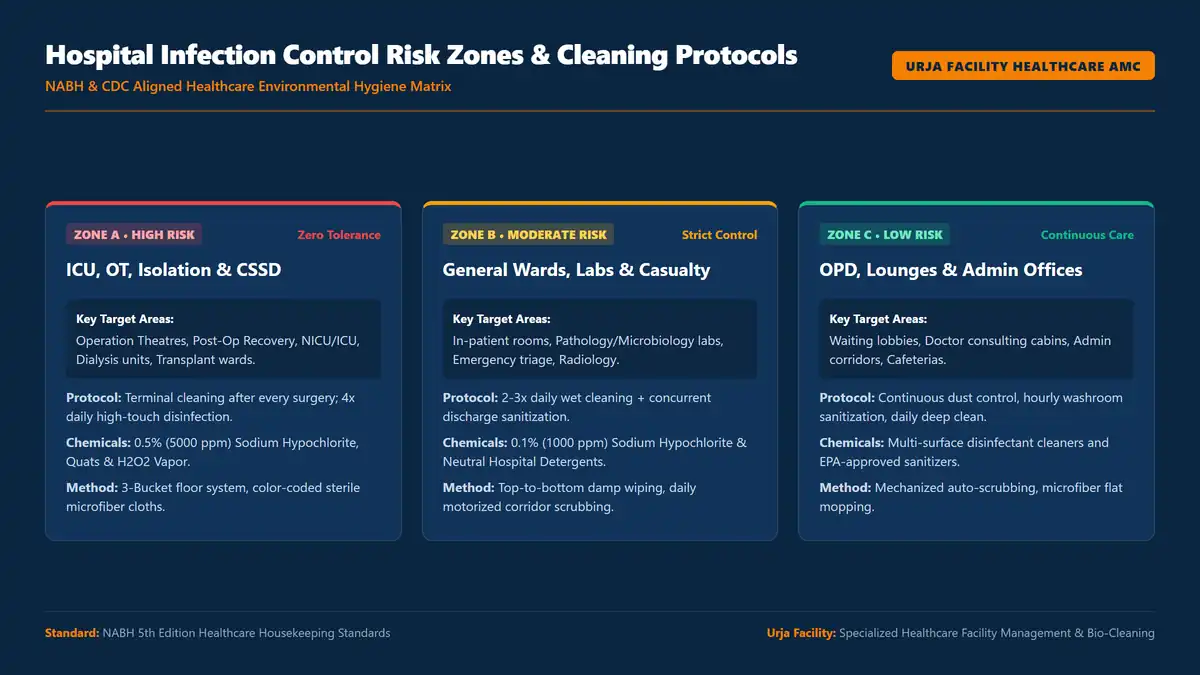
| Risk Zone | Hospital Departments Included | Sanitization Frequency | Recommended Disinfectant and Tool |
|---|---|---|---|
| Zone A (High Risk) | OT, ICU, NICU, Dialysis Unit, Burn Unit, CSSD, Isolation Wards | After every procedure / 4 times daily terminal clean | 0.5% (5000 ppm) Sodium Hypochlorite, Quats, 3-Bucket System |
| Zone B (Moderate Risk) | General Wards, Pathology Labs, Emergency, Radiology, Pharmacy | 2 to 3 times per shift + immediate spill response | 0.1% (1000 ppm) Sodium Hypochlorite, Neutral Hospital Cleaners |
| Zone C (Low Risk) | OPD Waiting Lobbies, Admin Offices, Doctor Lounges, Corridors | Continuous dust control + daily mechanized scrubbing | Multi-surface neutral detergent, motorized floor scrubber |
Implementing this risk-based approach prevents cross-contamination. Cleaning staff must never carry mops or wiping cloths from Zone B or C into Zone A. Dedicated, color-coded cleaning carts must remain stationed in their respective zones at all times.
NABH Compliant Hospital Housekeeping: Standards and Frameworks
NABH compliant hospital housekeeping mandates color-coded microfiber tools, documented chemical dilution logs, strict Biomedical Waste Rules adherence, permanent staff training and daily supervisor audits. It shifts environmental maintenance from superficial tidiness to validated microbiological safety across all clinical departments.
Achieving and retaining accreditation from the National Accreditation Board for Hospitals & Healthcare Providers (NABH) requires strict adherence to documented Standard Operating Procedures (SOPs). Under the NABH Hospital Infection Control (HIC) and Facility Management & Safety (FMS) chapters, housekeeping is evaluated as a clinical support pillar.
To ensure NABH compliant hospital housekeeping, your facility management operations must institutionalize four foundational controls:
01
Microfiber Color-Coding Matrix
Housekeeping staff must use strict color codes: Red microfibers for toilets and urinals, Yellow for isolation rooms and bed frames, Blue for general furniture and nurse stations, and Green for sterile procedural tables. This prevents pathogens from transferring between washrooms and patient care zones.
02
Documented Chemical Dwell Times
Disinfectants do not kill bacteria instantaneously. Staff must be trained on contact times. For instance, surface disinfectants must remain wet on surfaces for at least 3 to 5 minutes to neutralize viruses like Hepatitis B and resistant bacteria like MRSA.
03
Airborne Bio-Load Reduction
Dry sweeping is strictly prohibited under NABH standards because it disperses fungal spores and bacteria into the air. All floor care must utilize damp microfiber mops or mechanized auto-scrubbers equipped with HEPA filtration.
04
Digital Audit Trails and Sign-Offs
Every cleaning shift must produce verifiable records. Infection control supervisors must document chemical batch numbers, cleaning timestamps and surface swab culture results to pass regulatory scrutiny during NABH surveillance audits.
When healthcare facilities partner with professional facility management AMC providers, these compliance mechanisms operate automatically without distracting nursing supervisors from active patient care.
Sterile Area Cleaning Procedures for Operation Theatres and CSSD
Sterile area cleaning procedures require a 3-phase decontamination workflow including pre-case damp wiping, between-case turnover and end-of-day terminal deep cleaning. Staff utilize unidirectional wiping, enzymatic cleaners and hydrogen peroxide misting to eliminate all bacterial and fungal spores in surgical zones.
Operation Theatres (OT) and the Central Sterile Supply Department (CSSD) represent sensitive cleanroom zones in any medical facility. Surgical site infections (SSIs) carry severe clinical morbidity and financial implications. Applying structured sterile area cleaning procedures guarantees that airborne and surface bio-burdens remain within international ISO cleanroom tolerances.
OT environmental maintenance follows a structured three-tier schedule:
- Pre-Operative Morning Clean: 60 minutes before the first scheduled surgery, damp-dust all flat surfaces, surgical lights and monitor arms using an alcohol-free quaternary ammonium compound to capture overnight dust settling.
- Between-Case Turnover: Immediately after a patient leaves the theatre, bag all soiled linens and suction canisters. Wipe the surgical table, anesthesia trolley and mayo stands in a single unidirectional motion. Spot-clean the floor using a 0.5% chlorine solution before the next patient enters.
- End-of-Day Terminal Cleaning: At the conclusion of the surgical list, the entire OT suite undergoes a comprehensive scrub. Move all movable equipment to one side, scrub walls up to 6 feet, disinfect scrub sinks and mop floors with hospital-grade biocides. Periodically, perform hydrogen peroxide vapor (HPV) fogging to sanitize ceiling plenums and HVAC return grilles.
Just as manufacturing units rely on cleanroom GMP standards, surgical suites require dedicated staff who understand clean-to-dirty workflow mechanics and laminar air flow preservation.
ICU Sanitization Guidelines and Patient Room Disinfection Standards
ICU sanitization guidelines prioritize 5-stage patient room turnovers and 2-to-3-hour disinfection cycles for critical high-touch surfaces. Housekeepers disinfect IV pumps, ventilator panels and bed rails in single strokes, followed by 3-bucket floor sanitization and ATP surface swab verification.
Intensive Care Units house vulnerable patients undergoing invasive therapies. A minor lapse in surface hygiene can transmit multi-drug-resistant organisms such as Acinetobacter baumannii and Klebsiella pneumoniae. Implementing strict ICU sanitization guidelines and patient room disinfection standards forms the primary defense against ICU-acquired cross-infections.
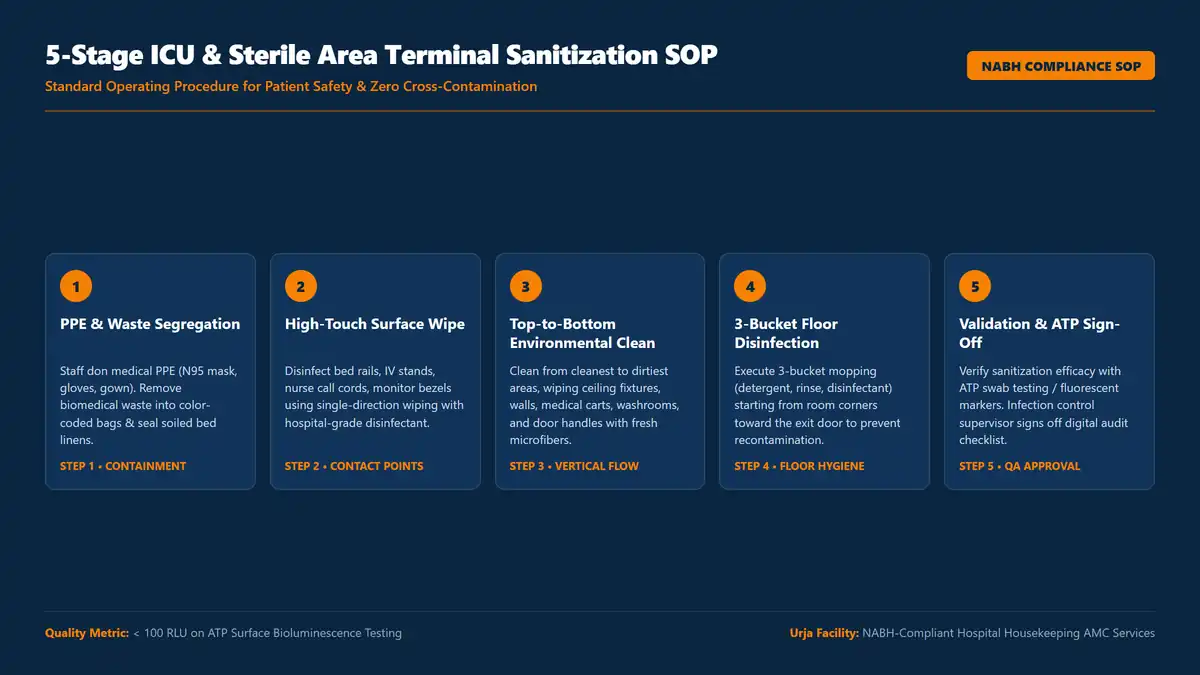
High-touch environmental surfaces require systematic disinfection throughout every 24-hour cycle. The key touchpoints include:
- Bed Controls and Rails: Wipe both upper and lower railings, adjustment remotes and bed footboards.
- Monitoring Equipment: Clean cardiac monitor bezels, touchscreens (using manufacturer-approved wipes) and blood pressure cuff housings.
- Infusion Hardware: Sanitize IV poles, syringe pump keypads and infusion tubing hooks.
- Patient Proximity Items: Disinfect nurse call pendants, overbed tray tables, oxygen flowmeter knobs and suction wall outlets.
When an in-patient is discharged, the room must undergo healthcare facility deep cleaning. The mattress, bed frame, privacy curtains, bathroom plumbing and window ledges must be chemically wiped and aired before admitting the next patient.
Hospital Waste Disposal Housekeeping: Biomedical Waste (BMW) Management
Hospital waste disposal housekeeping ensures complete compliance with the Biomedical Waste Management Rules 2016. Housekeeping teams collect, segregate and transport anatomical, plastic, glass and sharp wastes in designated yellow, red, blue and white puncture-proof containers with barcoded tracking to prevent hazardous exposure.
Managing biomedical waste is a strict legal responsibility under the Environment (Protection) Act. Improper segregation can lead to toxic contamination, needle-stick injuries among sanitation workers and cancellation of a hospital operating license. Proper hospital waste disposal housekeeping requires trained staff who recognize waste categories instantaneously.
Biomedical Waste (BMW) Segregation Protocol (Rules 2016)
- Yellow Bins (Incineration / Deep Burial): Human anatomical waste, soiled cotton, plaster casts, expired medicines and cytotoxic drugs. Use non-chlorinated plastic liners.
- Red Bins (Autoclaving & Recycling): Contaminated plastic waste such as tubing, disposable catheters, IV bottles, syringes without needles and blood collection vacutainers.
- Blue Cardboard Boxes / Bins: Glass bottles, medicine ampoules, vials and metallic body implants.
- White Translucent Containers (Puncture-Proof): Sharps, surgical blades, scalpel points and used hypodermic needles. Always pass needles through electric destroyers before disposal.
Waste bags must never be filled beyond two-thirds capacity. Sanitation crews must tie bag necks securely, affix barcode labels and transport them using covered wheeled bins along dedicated service corridors. Similar to our industrial protocols for hazardous factory safety guidelines, waste handlers must wear heavy-duty nitrile gloves, gumboots and fluid-resistant aprons.
Why Healthcare AMC Cleaning Contractors Outperform In-House Teams
Specialized healthcare AMC cleaning contractors provide trained personnel, modern mechanized scrubbers, guaranteed infection control SLA compliance and regulatory indemnification. They eliminate the staffing shortages, training deficits and chemical supply overheads associated with managing in-house hospital housekeeping departments.
Managing an internal housekeeping roster often creates administrative friction for hospital directors. Absenteeism, unverified background checks, chemical wastage and lack of specialized machinery result in inconsistent cleaning standards across shifts.
Partnering with dedicated healthcare AMC cleaning contractors offers decisive operational advantages:
- Continuous Staff Availability: An AMC contract guarantees designated staffing levels per shift. If a cleaner is absent, a trained replacement is deployed immediately, preventing wards from operating without support.
- Institutional Training: Cleaners undergo structured modules on spill management, hand hygiene, PPE protocol and hospital communication etiquette before deployment.
- Modern Equipment Deployment: Professional contractors bring industrial ride-on scrubbers, steam cleaners and high-filtration vacuum systems that hospitals rarely purchase outright.
- Full Labor Law Compliance: Verified staff receive PF, ESI and statutory benefits directly from the agency, shielding the hospital from third-party labor liabilities.
If you are reviewing vendor proposals, refer to our detailed guide on how to evaluate facility management AMC vendors to assess SLA parameters and contractor credibility.
Complete Medical Facility Cleaning Checklist for Administrators
A structured medical facility cleaning checklist organizes daily, weekly and monthly sanitization duties across outpatient, inpatient and clinical zones. It provides a measurable framework to audit surface hygiene, chemical compliance, equipment maintenance and terminal cleaning sign-offs.
Infection control officers need clear, repeatable mechanisms to supervise daily work. Using a standardized medical facility cleaning checklist ensures that no critical surface is overlooked during shift handovers.
| Frequency | Task Description | Responsible Person | Validation Method |
|---|---|---|---|
| Daily (Every Shift) | Damp mopping of patient rooms, high-touch point wipe-down, waste bin clearing and washroom scrubbing | Ward Housekeeper | Supervisor Checklist Sign-off |
| Between Patients | Terminal cleaning of discharged patient beds, mattress disinfection and fresh linen setup | Sanitation Specialist | Nursing In-Charge Inspection |
| Weekly | Mechanized scrubbing of corridor floors, high dusting of light fixtures and glass facade damp wipe | Floor Care Team | ATP Surface Swab Test |
| Monthly | OT deep cleaning, HVAC duct vent sanitation, drainage descaling and curtain change | Technical Bio-Clean Team | Microbiology Culture Plate Settle Test |
Integrating this checklist into daily operations establishes accountability, making every housekeeping technician an active guardian of patient safety.
How Urja Facility Delivers Hospital Bio Cleaning AMC Services in Indore
Urja Facility provides NABH-compliant hospital bio cleaning AMC services across Indore and Central India. Deploying verified staff, hospital-grade disinfectants, HEPA floor scrubbers and dedicated infection control supervisors, we ensure sterile hospital environments for healthcare institutions.
Healthcare facilities cannot afford trial-and-error facility management. At Urja Facility, we manage mission-critical cleanliness across healthcare, industrial and corporate spaces, serving more than 492 verified enterprise clients.
Our dedicated hospital bio cleaning AMC programs are tailored specifically for multi-specialty hospitals, diagnostic centers and nursing homes across Indore and Central India. We supply certified hospital housekeeping staff, automated scrubber driers and non-toxic hospital-grade disinfectants aligned with NABH guidelines.
When you choose our team for hospital sanitization services Indore, you gain a dedicated partner committed to zero-HAI benchmarks, full statutory labor compliance and transparent digital quality reporting. Discover how we support healthcare and commercial spaces across our industries we serve.
Key Takeaways for Hospital Administrators
Maintaining hospital sanitization standards requires disciplined clinical zoning, strict NABH-aligned SOPs, trained personnel and continuous microbiological validation. A structured healthcare AMC transforms environmental hygiene into a strategic asset for patient safety and institutional excellence.
Environmental cleanliness in healthcare is not a routine overhead; it is an active clinical intervention. By moving away from informal, unmonitored cleaning crews and adopting a structured AMC framework, your hospital safeguards patients against deadly infections, passes accreditation audits smoothly and reinforces public trust.
Take the next step toward clinical-grade facility management. Let Urja Facility evaluate your current hygiene protocols and design a customized, NABH-aligned housekeeping plan for your hospital.
Frequently Asked Questions
What are the core NABH compliant hospital housekeeping requirements?
NABH compliant hospital housekeeping requires color-coded microfibers to prevent cross-contamination, documented chemical dilution charts, strict Biomedical Waste Rules compliance, trained staff on permanent payroll and daily infection control supervisor audit sign-offs.
How does a hospital bio cleaning AMC differ from commercial office cleaning?
A hospital bio cleaning AMC focuses on microbial eradication, pathogen containment and chemical dwell times rather than cosmetic dusting. It requires trained healthcare cleaners skilled in handling bloodborne pathogens, terminal disinfection and biomedical waste separation.
What chemical disinfectants are used for sterile area cleaning procedures?
Sterile areas use 0.5% (5000 ppm) sodium hypochlorite for body fluid spillages, quaternary ammonium compounds (QACs) or accelerated hydrogen peroxide for medical equipment surfaces and hydrogen peroxide dry mist fogging for terminal room decontamination.
How frequently should high-touch surfaces be sanitized in an ICU?
High-touch surfaces in an ICU (such as bed rails, infusion pumps, ventilator screens and nurse stations) must be disinfected at least four times per shift (every 2 to 3 hours) and immediately after any patient procedure or body fluid contact.
Where can hospitals find certified hospital sanitization services in Indore?
Healthcare facilities in Indore and Central India can partner with certified facility management firms like Urja Facility, which provides trained, police-verified healthcare housekeeping teams aligned with NABH and CDC infection control protocols.