
 Healthcare
Your inventory is piling up, dust is settling on pallets and forklift tire marks are permanently staining your concrete floors. You are moving hundreds of boxes daily, but the actual environment housing those boxes is slowly deteriorating.
Every day you delay proper maintenance, airborne dust compromises your packaging. Misread barcode scanners slow down dispatch. Safety hazards risk costly worker compensation claims. A dusty godown doesn't just look bad, it actually eats into your profits and puts your stock at risk.
Understanding the importance of warehouse deep cleaning is the first step to protecting your assets. At Urja Facility, our thorough cleaning process ensures your storage space remains audit-ready and structurally sound. We tackle the hidden grime that manual sweeping leaves behind, turning messy sheds into safe workspaces.
How Warehouse Hygiene Standards Impact Inventory Management
Poor warehouse hygiene directly causes inventory errors. Airborne dust settles on barcodes, causing scanner failures and dispatch delays. Regular deep cleaning removes this industrial fallout, prevents pest infestations that damage stock and ensures compliance with strict regulatory audits required in FMCG and pharmaceutical logistics.
You cannot separate the quality of your storage environment from the accuracy of your inventory. When goods sit on racks for weeks, they become magnets for dust. This isn't just a cosmetic issue. Dust accumulation interferes with automated sorting systems and handheld scanners. A warehouse operator spending an extra five seconds wiping a barcode might not seem like much, but multiply that by thousands of picks per day and your labour costs skyrocket.
Technical issues aside, poor warehouse hygiene standards invite pests. Cardboard boxes and dark, undisturbed corners are perfect breeding grounds for rodents and insects. A single pest infestation can ruin lakhs worth of FMCG or pharmaceutical stock, leading to rejected shipments and permanently damaged client relationships. Maintaining a spotless environment is your primary defense line.
Then there is regulatory compliance. If your facility stores food items, pharmaceuticals, or sensitive electronics, government bodies and third-party auditors require pristine conditions. Failing a sudden hygiene inspection brings hefty penalties or even operational closures. By hiring professional cleaners, you keep your godown ready for surprise inspections. For highly regulated environments, check out our guide on GMP standards for cleanroom cleaning.
We see this constantly with our manufacturing clients across Indore and Pithampur. A clean facility boosts worker morale. People treat a spotless workspace with more respect, leading to fewer careless inventory damages and a more precise stock count.
Key Challenges in Facility Management for Logistics
Logistics facilities operate around the clock, leaving narrow windows for maintenance. Facility managers struggle with heavy forklift traffic causing oil spills and tire marks, rapid accumulation of packaging waste in aisles and high-ceiling dust that is impossible for in-house staff to reach safely without specialized equipment.
Running a logistics hub is non-stop work. Unlike an office building that empties out at 6 PM, your supply chain operates 24/7. Facility management for logistics means you have to balance maximum operational uptime with the absolute necessity of facility maintenance. Finding the right window to clean without disrupting the supply chain is a logistical puzzle on its own.
The floors take the heaviest beating. Forklifts and pallet jacks are constantly in motion. They leave behind stubborn rubber tire marks, hydraulic fluid leaks and grease spots. A small oil spill on a smooth concrete floor is a massive safety hazard. If an operator slips or a forklift skids, the resulting accident halts operations and drives up insurance costs. Dealing with these deep stains requires chemical knowledge and industrial scrubbers.
Common operational challenges include:
Packaging Debris Aisles quickly fill with discarded shrink wrap, broken wooden pallets and stray cardboard, creating fire hazards.
Overhead Dust Racking systems reaching 30 feet high collect dust that eventually falls onto the lower inventory tiers.
Ventilation Strain HVAC systems pull in dirt from loading docks, clogging filters and reducing air quality for your workers.
Your regular housekeeping staff cannot handle this safely. Sending a regular cleaner up a scissor lift to dust overhead beams is a massive liability. Professional services step in here, providing trained personnel who know how to navigate a live logistics environment safely.
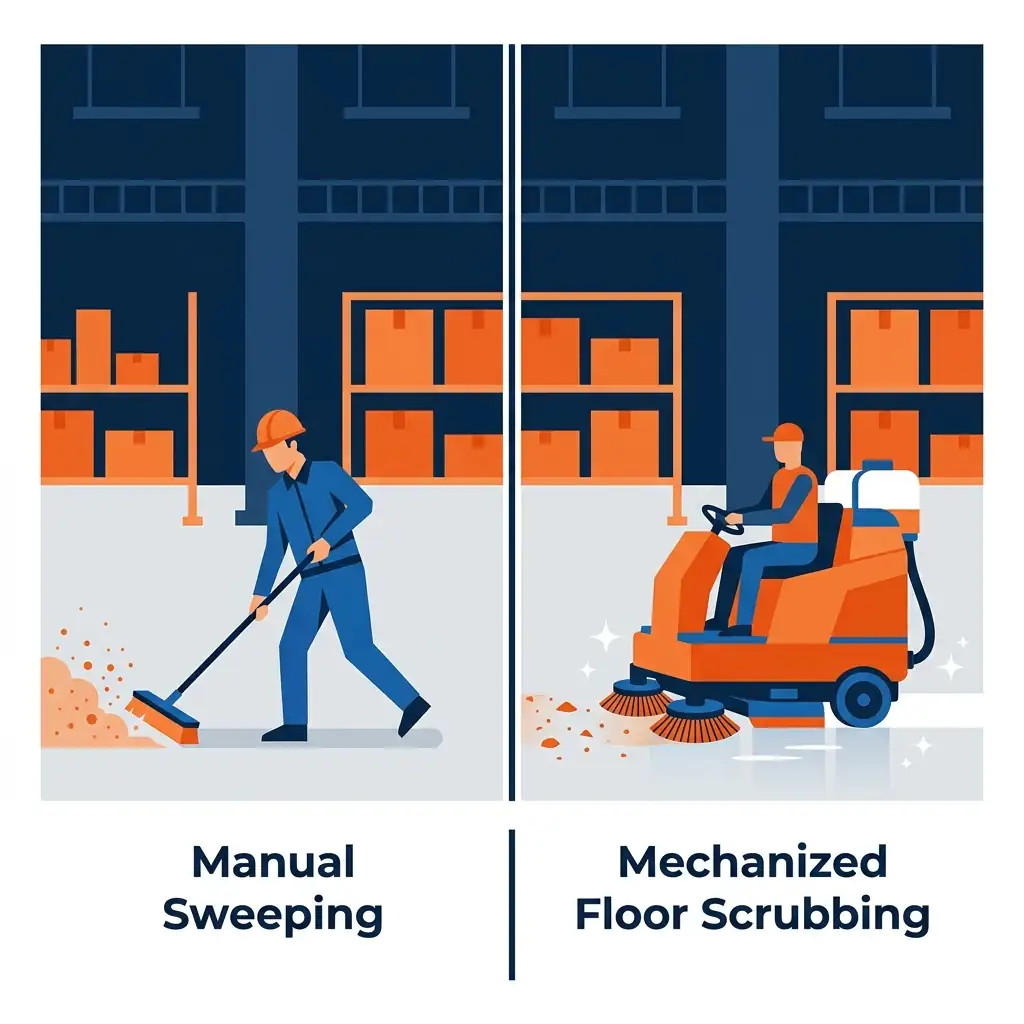
Benefits of Mechanized Floor Sweeping Warehouse Solutions
Mechanized floor sweeping easily beats manual cleaning by capturing dust at the source rather than pushing it into the air. Ride-on industrial scrubbers clean massive square footage in a fraction of the time, applying precise chemical mixtures and instantly drying the floor to prevent slip hazards.
The old method of handing a worker a wide broom and telling them to sweep a 50,000 square foot floor is just not working anymore. Manual sweeping simply pushes dirt around. It launches fine particulate matter into the air, which then settles right back down onto your inventory and racking systems. It just goes round in circles.
A mechanized floor sweeping warehouse strategy solves this completely. Industrial sweepers use powerful vacuum systems alongside their rotating brushes. They capture the dust before it has a chance to go airborne. When you switch to large scale warehouse sweepers, the air quality in your facility improves noticeably within a week.
For wet cleaning, ride-on auto-scrubbers make a massive difference. These machines dispense a precise mixture of water and industrial degreaser, aggressively scrub the concrete to lift tire marks and then immediately vacuum the dirty water back up. The floor is left completely dry and safe for immediate forklift traffic. You get a deeper clean while using significantly less water than traditional mopping methods.
| Feature | Manual Cleaning | Mechanized Cleaning |
|---|---|---|
| Speed & Coverage | Slow, struggles with large areas | Cleans up to 50,000 sq ft per hour |
| Dust Control | Pushes dust into the air | Vacuums and contains airborne particles |
| Deep Stains | Ineffective on oil and tire marks | Aggressive scrubbing removes tough grease |
| Drying Time | Leaves floors wet and dangerous | Instantly dries surfaces for immediate use |
Investing in heavy duty industrial sweeping saves money. One machine operator can finish in two hours what takes five manual cleaners a whole shift. This directly cuts down your AMC costs and keeps your loading docks running without disruption.
Exploring Industrial Floor Cleaning Services and Factory Shed Cleaning
Proper industrial floor cleaning removes embedded grease and extends the lifespan of expensive epoxy or concrete flooring. Factory shed cleaning targets high-level structures, like ceiling trusses, lighting fixtures and HVAC ducting, preventing combustible dust buildup and improving overall facility illumination.
Your flooring is a massive capital investment. Whether you have polished concrete or specialized epoxy coatings, letting dirt grind into the surface under the weight of forklifts destroys that finish quickly. Industrial floor cleaning services employ specialized pH-neutral chemicals that break down grease without degrading your floor sealants. Regular maintenance extends the lifespan of your flooring by years, delaying expensive resurfacing projects.
But the floor is only half the battle. Look up. The roof structure of your logistics centre quietly collects industrial fallout, exhaust fumes and airborne dirt. Over time, this buildup becomes a severe hazard. Factory shed cleaning is highly specialized work. It involves using aerial work platforms and specialized vacuums to clean ceiling trusses, purlins and overhead piping safely.
Cleaning high-bay lighting fixtures is particularly valuable. A thick layer of dust on your lights easily reduces the lux levels on the floor. When you clean the fixtures, the warehouse instantly looks brighter. Better visibility means your forklift operators drive safer and your pickers make fewer reading errors.
We often bundle warehouse sanitization services into these deep cleaning projects. We focus on high-touch zones like loading dock control panels, dispatch offices and operator cabins, ensuring a hygienic environment that keeps your workforce healthy during peak seasons.
Post-Construction Warehouse Cleaning: Preparing for Operations
Before setting up racking or moving goods into a new godown, post-construction cleaning removes fine cement dust, silica particles and stray metal shavings. This important step prevents construction debris from circulating through the HVAC system and permanently contaminating your new stock.
Opening a new facility is a big moment. However, the handover from the construction contractor is rarely as clean as you need it to be. Construction sites generate massive amounts of fine particulate matter, especially cement dust and silica. If you start installing your racking systems and loading inventory into a dusty shed, that dust will plague your operations for months.
Post-construction warehouse cleaning is a non-negotiable step before operational launch. Our team enters the site to perform a top-to-bottom detail clean. We vacuum the fine dust out of expansion joints, remove paint splatters from the polished concrete and clear away stray metal shavings left behind by contractors.
We also flush the HVAC vents. If you turn on the air conditioning in a dusty new building, the system sucks up the construction debris and constantly redistributes it over your clean inventory. A professional deep clean ensures you start your logistics operations with a truly blank slate, protecting your brand new assets from day one.
Conclusion
Ignoring facility maintenance creates a chain reaction of daily problems. From barcode scanning errors and pest infestations to unsafe floors and poor worker morale, the hidden costs of a dirty logistics centre far outweigh the investment in professional care. The importance of warehouse deep cleaning lies in protecting your inventory, keeping your workers safe and protecting your building.
Stop relying on basic brooms to manage industrial-grade dirt. Partnering with a professional team ensures your space meets global compliance standards while you focus entirely on your core logistics. Let our team handle the heavy lifting.
Frequently Asked Questions
What is included in industrial floor cleaning services?
Industrial floor cleaning services include automated scrubbing, sweeping, oil spill removal and degreasing to maintain safe, non-slip concrete surfaces in logistics and manufacturing facilities.
How often should we schedule heavy duty industrial sweeping?
High-traffic logistics hubs require daily mechanized sweeping to control dust, while heavy duty industrial sweeping should be scheduled quarterly to manage tire marks and embedded grime effectively.
Does post-construction warehouse cleaning include high ceiling areas?
Yes, proper post-construction warehouse cleaning involves vacuuming overhead beams, HVAC vents and lighting fixtures to remove cement and silica dust before it circulates into your clean inventory zones.
Why are warehouse hygiene standards critical for third-party logistics (3PL)?
3PL providers must protect their clients' goods from dust contamination and pest damage. Maintaining high warehouse hygiene standards prevents inventory loss and ensures compliance with strict external audit requirements.